
The German education system


Fact 1: Education in Germany is primarily regulated by the government. The federal authority, however, has only minor power to ensure uniformity of their systems, while each state (Land/Bundesland) regulates its own education policy.
Fact 2: In Germany, it is mandatory for children to study for at least 9 years in primary and secondary schools.
Fact 3: In general, homeschooling is not authorized in Germany. However, there are still exceptions to allow homeschooling, for example:
- The child suffers from serious illnesses and must stay away from school.
- The child is not suited for school / "cannot learn".
- The child is a victim of persistent bullying by other children, displaying behavioral problems, etc.
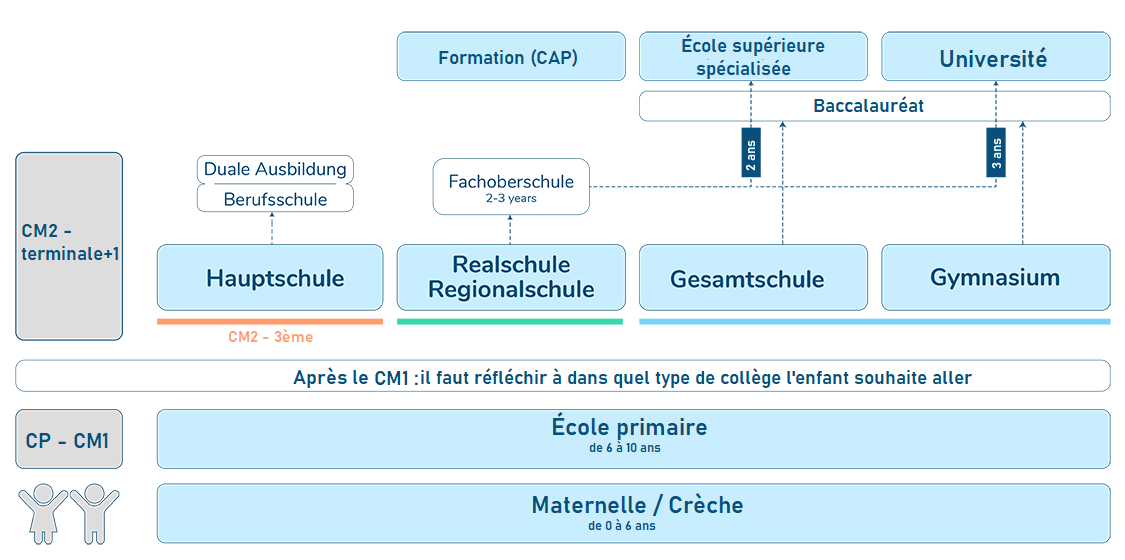
Below, our summary diagram and an explanation of the school system in Germany:
The nursery/preschool level
Nursery/preschool is optional (not mandatory) for children under 6 years old. There are 3 types of preschools in Germany: Kinderkrippe, Kindergarten, and Kita.
- Kinderkrippe: is considered a nursery — daycare for babies from 3 months to preschool age (3 years).
- Kindergarten: is for children aged 3 to 6 years.
- Kita (Kindertagesstätte = childcare center): organizes after-school and sometimes preschool activities for children aged 3 to 6 years.
Primary school (Grundschule)
Primary school (Grundschule) is mandatory for all children aged 6 to 9 years, from 1st to 4th grade, except in Berlin and Brandenburg where Grundschule can last 6 years: from 1st to 6th grade. After primary school, depending on their abilities, students can continue their education in one of the following different types of secondary institutions: Hauptschule, Realschule, Gymnasium, Gesamtschule, Regionalschule, or Gemeinschaftsschule.
In addition, there is Kinderhort/Schulhort, which is a form of after-school center, similar to Kita, but intended for children between 7 and 12 years old. At Kinderhort, children can eat lunch, do their homework, and play with their peers.
Secondary school (Sekundarstufe I)
Secondary school (Sekundarstufe I) is mandatory for all children. It is highly stratified and serves as a means to assess children's abilities. The following types of secondary school are distinguished:
- The Hauptschule is for students who show the least academic ability. They will study at the Hauptschule for 5 years (grades 5 to 9) and finish with a final exam called "Hauptschulabschluss". After that, they can move up to Berufsschule or Berufsausbildung (vocational schools) for the next 2-3 years.
- The Realschule is for intermediate-level students and lasts 5 years (grades 5-9) or 6 years (grades 5-10) depending on the state. Students finish the Realschule with a final exam called "Mittlere Reife" (or Realschuleabschluss). After the Realschule, students can attend a Berufsfachschule (vocational school) or Fachoberschule (Duale Ausbildung — dual training school combining vocational training or in-company apprenticeship) for the next 2 or 3 years. If students have excellent performance at the Realschule, they may be transferred to the Gymnasium after obtaining their diploma.
- The Gymnasium is for high-level academic students who aim to continue their studies at universities or institutions. It lasts 8 to 9 years (from 5th to 12th or 13th year depending on the state). After the Gymnasium, students must pass the Abitur exams (higher education entrance diploma) to enter universities or equivalent institutions.
- The Regionalschule is only available in certain German states. It is a combination of Hauptschule and Realschule. At the Regionalschule, a student can study for 9 years to obtain a Berufsschule certificate (equivalent to Hauptschulabschluss) or 10 years for the Mittlere Reife, which is equivalent to the Realschuleabschluss.
- The Gesamtschule is the combined form of Hauptschule, Realschule, and Gymnasium. Students can study for 5 years to obtain the Hauptschulabschluss, 5 to 6 years for the Mittlere Reife / Realschuleabschluss, and 8 to 9 years for the Abitur, depending on each state's regulations.
- The Gemeinschaftsschule was created following a pilot project carried out during the 2008/2009 school year and is now primarily managed like private schools in Germany. It is a binding form of Hauptschule and Realschule, as well as Gymnasium under certain conditions, which facilitates the transfer of children between different levels of study and creates equality for all children. Students at the Gemeinschaftsschule can study from 1st to 10th grade or up to 13th grade in a single school.

Higher education level in Germany
- The Fachschule is a technical school with specialized training. After obtaining their Berufsschule (vocational school) or Fachoberschule (Duale Ausbildung — dual training school combining vocational training or in-company apprenticeship) diploma, students can either continue their studies at a Fachschule if they want to become a qualified engineer, or gain experience in business, management, and services. Students who graduated from the Realschule with good results can also be transferred directly to the Fachschule.
- The Berufsakademie is a dual education system that combines the study of theoretical knowledge and professional experience in companies. The Berufsakademie is governed by the state (Bundesland). Companies participating in this system will pay both the training fees and the students' salaries.
Types of universities and/or equivalent institutions in Germany:
-
The Universitäten (traditional universities) are institutions with the right to award doctorates in the field of scientific development through research, teaching, and studies.
-
The Technische Universitäten/TU (technical universities) are institutions that award doctorats and offer a wide range of engineering and scientific subjects, supplemented for the most part by other subjects.
-
The Fachhochschulen/Hochschulen für angewandte Wissenschaften/Hochschulen für angewandte Forschung (Universities of applied sciences / higher education institutions of applied sciences) are study and research higher education institutions with application-oriented approaches based on scientific foundations.
-
The Technische Hochschulen (colleges of technology) designate institutions specializing in natural sciences and engineering sciences.
-
The Musik- oder Kunstakademien (academies for arts and music) offer higher education in visual arts, design, performing arts, film and television, a variety of musical and artistic subjects, as well as the theoretical disciplines of the aforementioned subjects. Some schools specialize in only one major while others offer multiple choices for different subjects.
You will find more information about types of German universities in this article.
Normally, one of the criteria for university entry in Germany is obtaining the Abitur or an equivalent diploma. However, many non-European students may not be admitted to university because their high school diploma is not considered equivalent to the Abitur. Therefore, it is necessary for these students to successfully complete two semesters in a preparatory class (Studienkolleg) before being admitted to a German university. For more information about the Studienkolleg, don't hesitate to read this article.

As we all can see, the school system in Germany has an important classification of students from the secondary level and is also thought to be more complicated than education systems in other European countries. In Germany, students are trained to play their role in the labor market based on their abilities and willingness. Thanks to this well-organized education structure, Germany has become one of the leading producer countries in Europe and ranks among the top four largest economies in terms of GDP, according to Focus Economics. It is worth spending your study time in a country that has one of the best education systems in the world.
Preparing to study in Germany?
Secure your official blocked account and student health insurance in one official, fast package approved by German authorities.