
Creating a successful application portfolio


1. What is an Application Folder?
An application folder (in German: Bewerbungsmappe) is the collection of documents presented when applying and includes:
- an outer envelope
- a cover letter
- a cover page (optional)
- a CV
- your certificates
- your qualifications
- your work references
- other important documents for the application
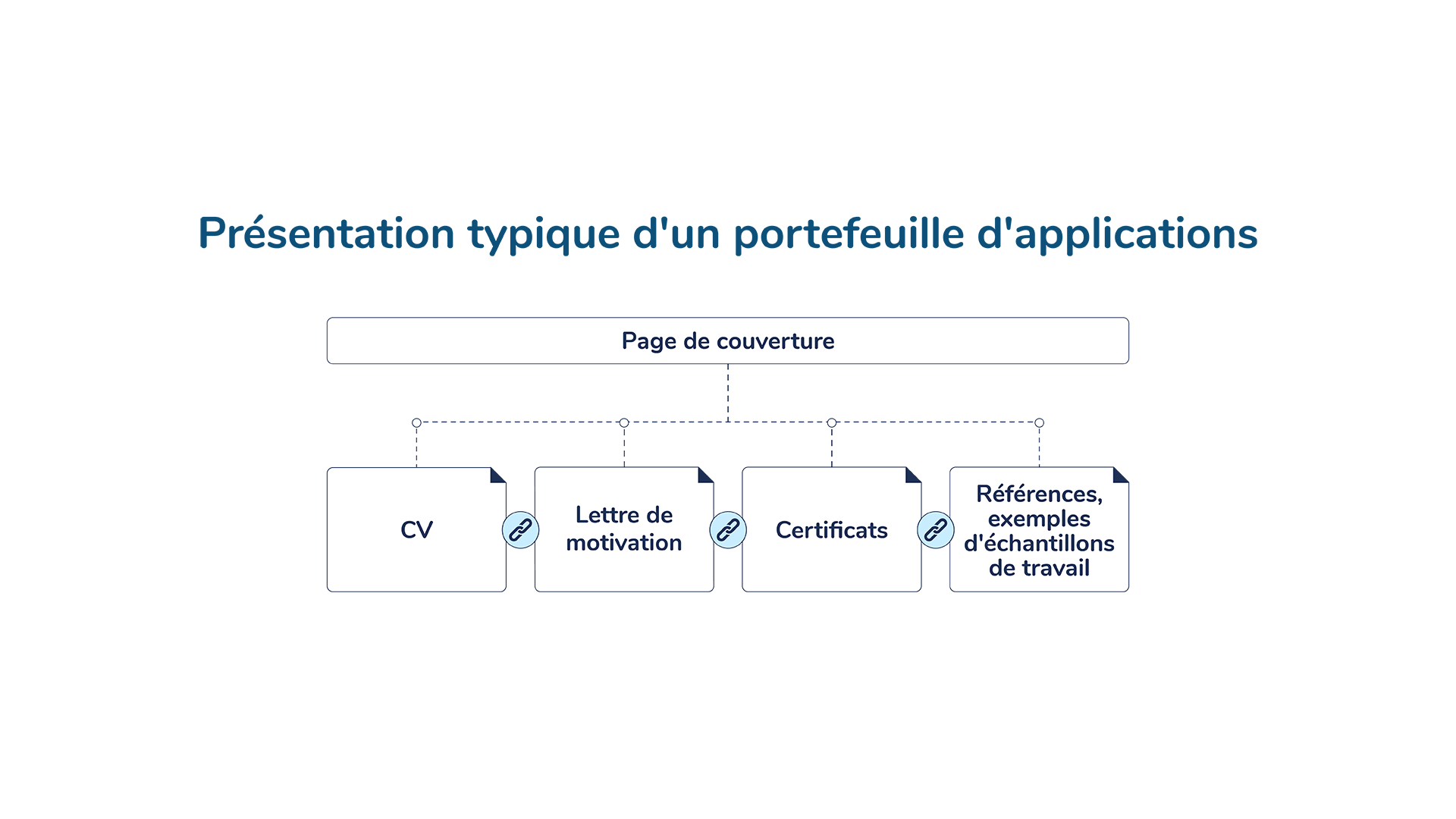
The application folder must be sent by mail or submitted in person to the company concerned if required in the job posting. It can also be useful for an unsolicited application, but as a general rule, an online application is faster, cheaper, and more convenient.
2. Document Arrangement in the Application Folder
There are certain guidelines for arranging documents in a classic application folder:
2.1. The Outer Envelope (äußere Hülle)
Many candidates wonder what type of folder they should use for their application documents: a simple spring binder or a high-quality three-part folder? A plastic or premium cardboard folder?
The right choice depends on the position you're applying for. For an intern position, a simple plastic spring binder is usually sufficient. For academic professions, a high-quality cardboard application folder is often preferred.
The application should express your personality. However, try to appear professional - for example, the folder should be in a classic color.
Additionally, pay attention to the recruiters' expectations. If you have the chance to speak with recruiters before submitting your application, you can ask them if they prefer a specific type of folder. Many recruiters prefer simple spring binders because they can remove documents (cover letter, CV, etc.) from the application folder, while three-part models are often too bulky. Other recruiters appreciate three-part application folders because the CV and certificates are presented side by side and can be read simultaneously.
2.2. Cover Letter (Anschreiben)
The cover letter represents your motivation and must be related to the position you're applying for. It should not exceed two pages, and one page would be better, and must answer the following questions:
- Why are you applying for this position? - e.g., interesting tasks, career opportunities, new challenges, etc.
- Why did you choose this company? - e.g., market position, industry, products, brand image, etc.
- What professional qualifications do you bring? - e.g., continuing education, practical experience, intercultural skills, social commitment, etc.
- What interests you about this profession? - e.g., company vision, career opportunities, variety of tasks, chances for individual achievements, etc.
- Why should the company hire you? - e.g., industry knowledge, practical experience, general skills, negotiation ability, attention to detail (in professional life), etc.
2.3. The Cover Page (Deckblatt) - Optional
The cover page is the first page of the application and normally serves as a business card. There are many ways to present this page, but in general, the following information should be provided: title, contact details, photo.
The title of the cover page should be written in a larger font than the rest. It could be "Application as...", "Application for the position of...", "Unsolicited Application", etc. You can also use your own name as the title of the cover page, but this is not recommended. In short, it should be clear to recruiters that this is an "application."
Your contact details can be written in the header, footer, or in a text area, but they must be clearly visible and include your name, address, phone number, and email address. Additionally, you can add your date of birth, but this is optional.
The photo should be professional and placed in the center of the cover page. If you want to include a photo in your CV, you should take a different one so that recruiters can have a fresh impression of you.

2.4. The CV (Lebenslauf)
A (tabular) curriculum vitae should not exceed two pages in A4 format and should be composed roughly of the following 5 elements presented in a clear structure:
- Personal information: first name, last name, date and place of birth, current address, phone number, email address, photo (optional).
- Work experience: previous positions, names of companies you worked for, employment periods, job description, training, and internships.
- Academic experience: higher education institutions and faculties, completed studies, study period, fields of specialization, final grade (optional).
- Special skills: continuing education, experience abroad, certificates, foreign languages, computer skills, awards, etc.
- Interests: hobbies, volunteer work, social commitments.
- The CV must be dated and signed.
Personal information should be placed at the top of the CV. In particular, the term "CV" and the candidate's full name (first name, last name) should be highlighted in bold and large font. A photo is optional, however, most recruiters prefer it because it helps complete the candidate's profile. Information about citizenship, marital status, or religion is also optional because they can, in some cases, lead to discrimination.
Whether the CV is convincing or not depends on your career history, which we recommend presenting in reverse chronological order. This means you start with the current activity, then work backward in time. Use meaningful and short keywords, write dates on the left and information on the right. Recruiters are interested in four important details:
- Duration: How long have you been working?
- Employer: Which companies have you worked for?
- Your previous positions
- Tasks and achievements: What were you responsible for? What did you accomplish?
Your educational background should also be presented in reverse chronological order. This means the most recently obtained degree should be mentioned first, followed by previous ones up to elementary school. However, recruiters are mainly interested in where you obtained your bachelor's, master's, or doctoral degree. The more work experience you have and the older you are, the less important information about your school is.
Special skills should be chosen based on the position you're applying for to provide added value. For example, if you're applying for a position at a multinational company, you should mention that you speak three foreign languages fluently, which will facilitate communication with your foreign supervisors. On the other hand, a certificate in Asian cooking won't be interesting to recruiters.
Your interests can include general skills, commitments, or experiences. For example, if you voluntarily lead a club, this already demonstrates your first leadership skills, organizational ability, and teamwork. The same goes for sports like football, handball, volleyball, or hockey, which are considered favorable indicators for teamwork.
Your CV should include the place, date, and signature to confirm that the information provided is true.
For more information, check our article on writing a good German CV. It should include certificates such as academic or vocational training certificates, diplomas (e.g., language courses, computer skills, awards), as well as internship and employment certificates.
The application folder should present the candidate in the best possible way to convince recruiters. That's why you should review it carefully to ensure everything is correct and in the right order. A clear structure saves a lot of time and avoids extra work. Good luck!
Preparing to study in Germany?
Secure your official blocked account and student health insurance in one official, fast package approved by German authorities.