
How to create a standard CV for your university application

We'd like to explain what a standard German CV looks like and how a CV for job applications differs slightly from university applications. If you need help writing a CV for a job application in Germany, check out this EDUBAO article!
Let's get started!
CV for University Applications vs. CV for Job Applications
CV for Job Applications:
- The CV: the most important document for job hunting. It should be structured in a concise and coherent way.
- Under personal information, you can give a brief description of yourself and your skills. In this space, the candidate describes their specific skills, experience, and field of study in a general way.
- With the CV used for job applications, employers want to learn more about the candidate's area of interest, work experience, and professionalism.
CV for University Applications:
- Since universities don't just focus on your work experience but also on other aspects, including your passion. In this summary section, you need to mention the reasons why you chose this program and the value you hope to gain from it.
- A CV for a university application highlights your level of study, grades, awards, and distinctions in detail. You can also include courses related to your degree or your overall GPA from previous studies.
The German CV Format
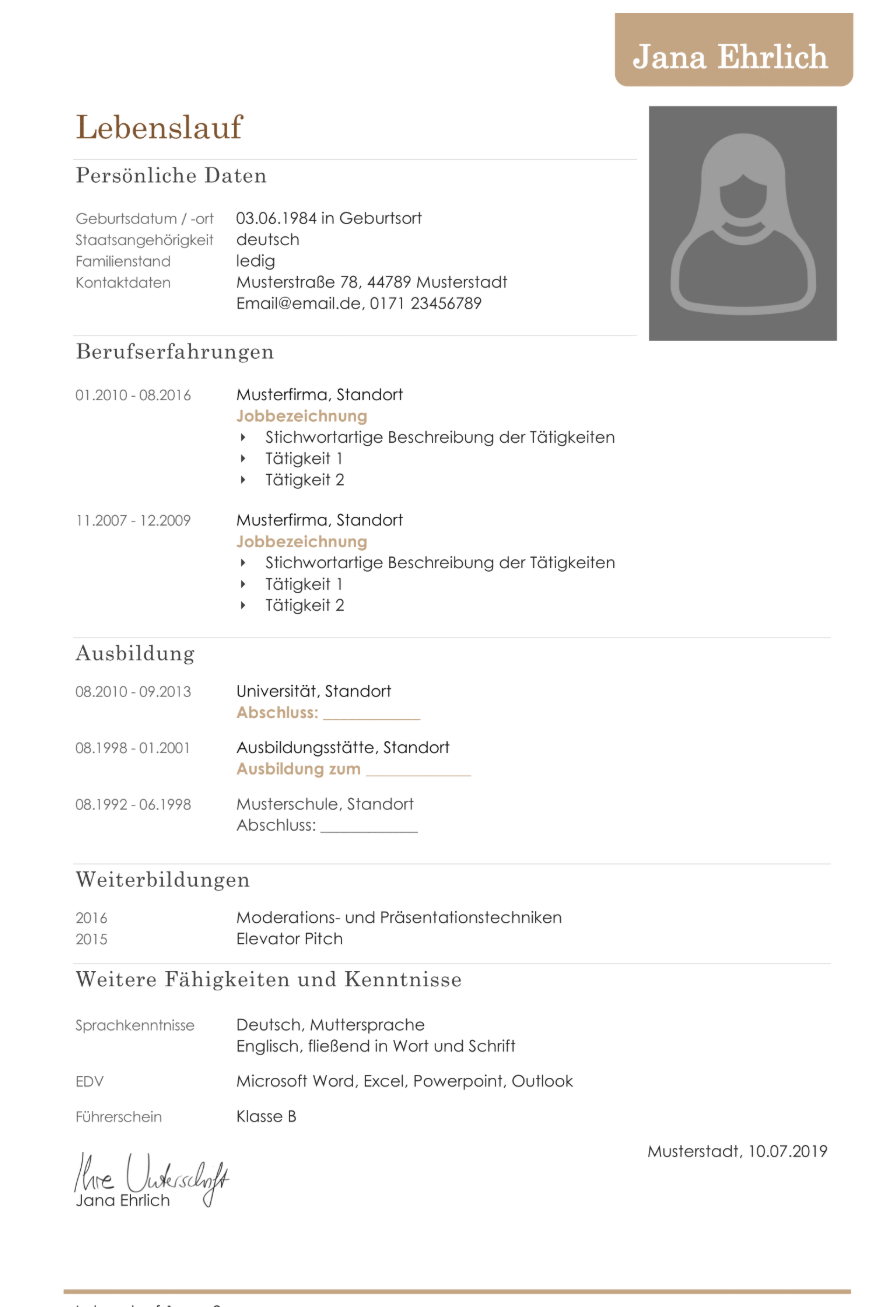
This is the general format of a CV used for all applications. The length of your CV varies depending on the information you include. But in general, it should not exceed 2 pages!
Source: bewerbung.net
The items listed here are essential for your university CV:
(1) Personal Information (persönliche Angaben): It is common in Germany to include these items in your CV:
- Your full name in bold in the header
- Address
- Nationality
- Date and place of birth
- Marital status is optional
- Email and mobile number
(2) Education and Grades (Ausbildung): For students: your educational background should be presented in reverse chronological order. EDUBAO suggests mentioning your studies from most recent to high school. It would be good to add your GPA from previous studies, the names of your schools, and your subjects.
(3) Work Experience / Volunteer Activities / Extracurricular Activities (Berufserfahrungen): For your university application, you may not have much experience as a student yet. But don't worry! Try to mention any relevant activities within universities or volunteering that you believe can highlight your strengths and align them with the field of study you're applying for or your skills.
(4) Other Skills or Achievements (Weitere Fähigkeiten und Kenntnisse): In this section, we strongly recommend adding items such as your language skills, computer skills (e.g., Microsoft Office), your driver's license (Führerschein), etc.
(5) Continuing Education Experience (Weiterbildung): This section is optional. All seminars, events, or online workshops related to your field of study or that can help you build a good career image - add them!
(6) Your Signature: Don't forget it, along with the date and location, as these are mandatory for all German CVs.
Conclusion
EDUBAO hopes this information will be helpful when you apply to German universities. If you have any questions, don't hesitate to send us a message - we're always here to help!
Preparing to study in Germany?
Secure your official blocked account and student health insurance in one official, fast package approved by German authorities.