
How high are tuition fees for studying in Germany?


The main tuition fees in Germany
What is the free education system in Germany like?
In the early 1970s, Germany began requiring a small contribution from students (about 120 to 150 D-Mark), known as Hörergeld (listeners' money).
In 2005, the Federal Constitutional Court (Bundesverfassungsgericht) adopted a new law allowing German states to decide on tuition fees. However, these fees must be affordable so that students can either self-finance or take out a loan to pay them. Subsequently, in 2006, the first seven German states, including Hamburg, Hesse, Lower Saxony, North Rhine-Westphalia, Bavaria, Baden-Württemberg, and Saarland, officially announced their tuition fee systems.
In 2014, following the political decentralization from the CDU government (Christian Democratic Union) to the SPD (Social Democratic Party of Germany), a referendum was held to abolish the tuition fee law. And school was officially "free" again.
Starting from 2017, tuition fees are again imposed in certain states or certain universities only; however, they are still too low compared to other countries. You can still study at many public universities and colleges without tuition fees, at least for the first degree.
Arguments for and against tuition fees

For years, the question of "tuition fees" has been raised in many discussions. Those who are for tuition fees and those who are against them all have their own reasons and defend their ideas.
Reasons of the tuition fee proponents:
- According to those who claim tuition fees are necessary, these fees promote awareness and effort among students, encouraging them to finish their studies earlier. Consequently, students will work harder and more smartly. The higher the tuition fees, the fewer students attend universities. They might instead opt for a vocational high school. *Tuition fees also contribute to the university's budget for hiring good professors or investing in infrastructure and facilities, which in turn improves the quality of education as well as the life and studies of students.
Opposition of those against tuition fees:
- Tuition fees could create a financial barrier for young people and deprive low-income students of the chance to study.
- Students risk being overwhelmed by part-time jobs to afford their studies and will therefore spend less time studying.
Special types of tuition fees or equivalent fees
Is it free to study in Germany nowadays?
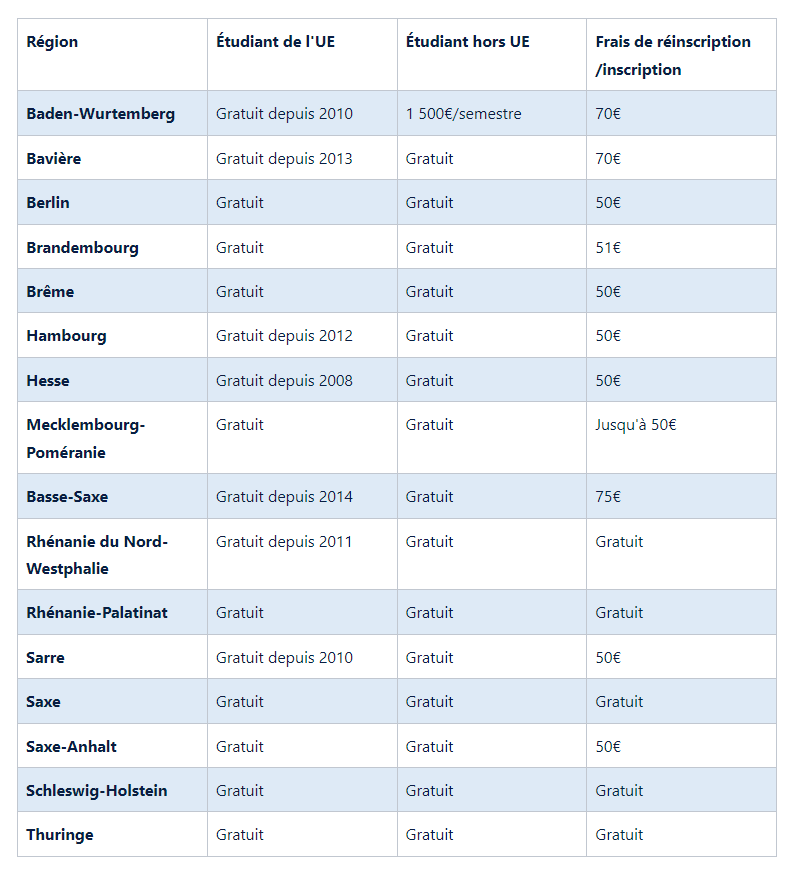
Only the general tuition fees have been abolished! Other forms of fees are still applied for studies, even if they may not cost very much. These could be long-term study fees for the 2nd year or for graduate studies, or a contribution to administrative costs, etc. In addition, a student may be charged a small amount upon enrollment. In Baden-Württemberg, tuition fees will be charged to non-European students, unlike European students.
Some types of fees by state are summarized in the following table:
What other types of fees might arise?
Besides the general tuition fees (which are free for undergraduate studies), a student must take into account the following additional fees or contributions:
- Semester contribution: for administration — approximately €100–350/semester
- Fees for more advanced studies (master's) (unfortunately, these often exist even in countries that do not charge students)
- Fees/charges for additional school offerings that are not part of the study program, such as German language courses for international students who wish to study in German but do not yet speak German, etc.
- Registration fees for "visiting" students
Additional fees for special cases:
- Contribution for studies at certain state universities
- Tuition fees for non-European students: only apply to learners not from the EU/EEA. The exception is granted to Bildungsinländer (non-mobile foreign students) who obtained their Abitur in Germany. These students would not be charged non-EU tuition fees.
- Study account: effective registration fees, paid only by students who study for more than 16 university semesters
- Senior courses: tuition fees for all persons aged 55 and over in Saarland or 60 in Rhineland-Palatinate and Thuringia.
- Long-term study fees: for additional studies from the 10th to the 13th semester at university.
- Second degree fees: included in the long-term study fees or study account, as these regulations include the semesters of the first degree.
Tuition fees for long-term students or second degrees
Unlike the general tuition fees, which were intended for a first degree in Germany and have been abolished, there are however other contributions imposed in some federal states, which must, for example, be paid for a second degree or for exceeding the standard duration of studies.
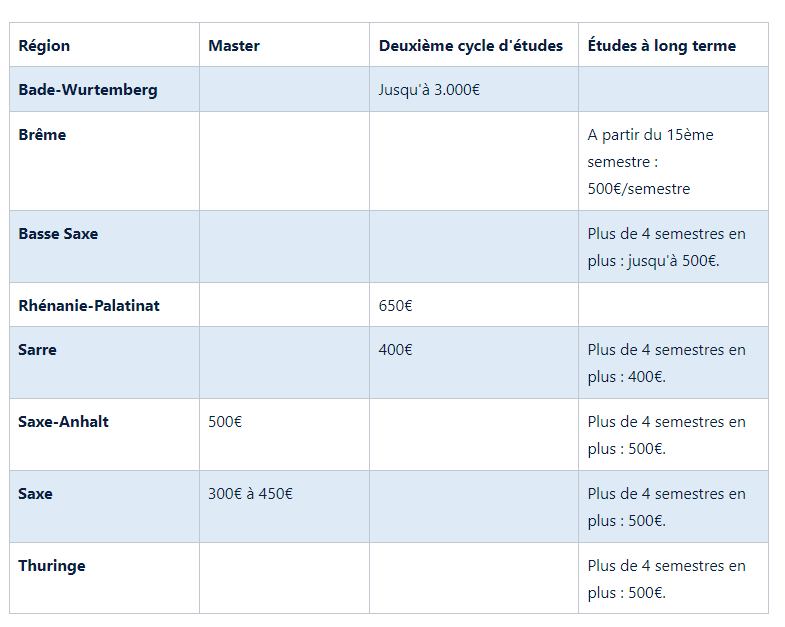
Other states, including Bavaria, Brandenburg, Hamburg, Hesse, Mecklenburg-Western Pomerania, North Rhine-Westphalia, Saarland, Schleswig-Holstein, and Berlin, do not impose general tuition fees on students at all levels.
Student loan and tuition fee deduction
For students who cannot self-finance or are not financially supported by their families, they can apply for a student loan for tuition fees (if applicable) through the Federal Education and Training Assistance Act (BaföG / Bundesausbildungsförderungsgesetz) or use assets as collateral.
Of course, not all students can receive BaföG. You can check the eligibility requirements here: in simplified German or in standard German.
Preparing to study in Germany?
Secure your official blocked account and student health insurance in one official, fast package approved by German authorities.