
Do you need to speak German to study in Germany?


German Language Proficiency Assessment Framework (GeR)
To study at a higher education institution in Germany, you can prove your German skills by taking two different tests. One is the DSH (German language university entrance exam for foreign candidates), and the other is the TestDaF (Test German as a Foreign Language).
Before learning more about the two main German language tests you might need to take, you should have some basic knowledge about the assessment framework — GeR.

GeR (Gemeinsamer europäischer Referenzrahmen für Sprachen) — Common European Framework of Reference for Languages
You may have heard that level B1 is the basic level for studying in Germany. But what does level B1 actually mean, and how do you know if your German is at that level? The answer is in the following table, which contains a detailed description of the CEFR (in German: GeR — Gemeinsamer europäischer Referenzrahmen für Sprachen). This is a European common reference framework for European languages, including English, German, Italian, Spanish, etc. We'll also use this framework in future articles to describe language proficiency in other articles about the German language, so it's necessary to read this table to get an idea.
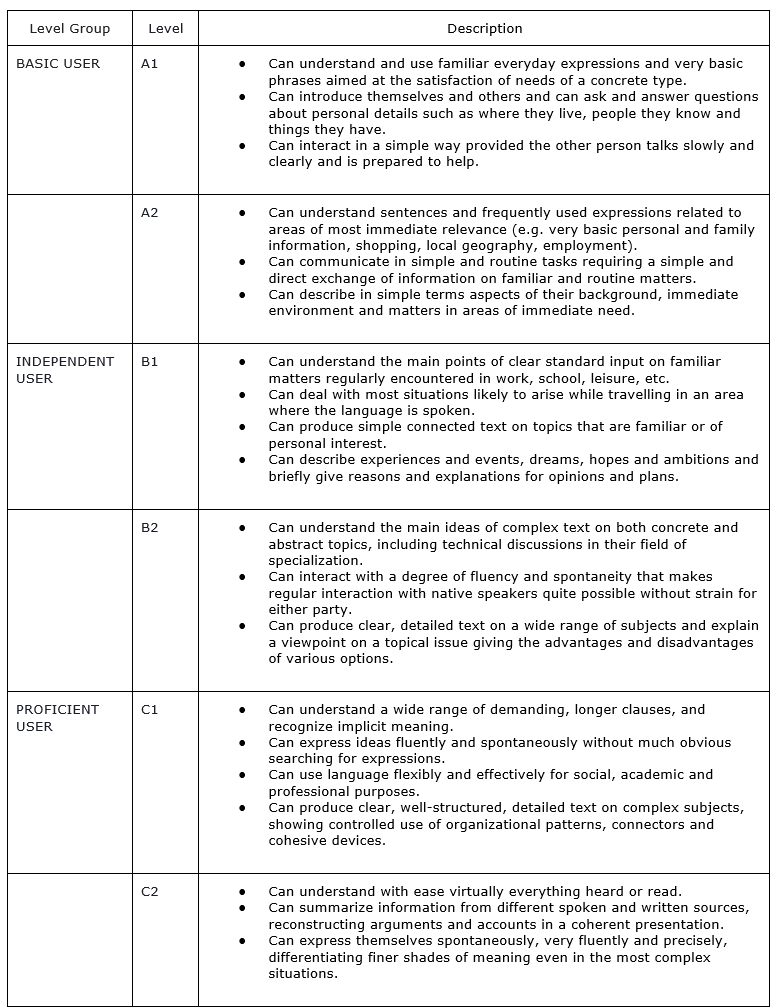
Source: Council of Europe — Common European Framework of Reference for Languages
It is mainly required that students submit a DSH2 certificate or a 4-TN4 TestDaF certificate. For students who want to take courses requiring a deep understanding of the German language, such as German literature, etc., they will be asked to demonstrate language skills at a more advanced level, for example a score of 18 points or more on the TestDaF (2-TN4 and 2-TN5). But if you fall into the following cases, you don't need to submit a language certificate:
-
You obtained an Abitur at a German-speaking secondary school.
-
You passed the new C2 certificate from the Goethe Institute: Major German Language Diploma or one of the former minor or major German Language Diplomas or the Central Advanced Language Test (until 2011), or you passed the Goethe Institute C2 "Großes Deutsches Sprachdiplom" certificate (from 2012).
-
You obtained the German Language Diploma (Phase II) from the Standing Conference of the Ministers of Education and Cultural Affairs.
-
You passed the "telc Deutsch C1 Hochschule" exam.
German Language Tests

TestDaF (Test German as a Foreign Language)
Before arriving in Germany, you can take the TestDaF in your home country. The TestDaF is administered six times a year, except in China where it's administered only three times, and is offered in more than 90 countries. For more information on test centers, schedules, fees, implementation processes, and much more, you can visit the TestDaF website.
DSH (DEUTSCHE SPRACHPRÜFUNG FÜR DEN HOCHSCHULZUGANG)

Unlike the TestDaF, the DSH (Deutsche Sprachprüfung für den Hochschulzugang = German Language Test for University Admission) can only be taken in Germany. This exam is offered by many universities. You should therefore contact your university's international office for information on test dates. You can also take preparatory courses for the DSH at universities. Once you receive an admission letter for these courses, you can attach it to your visa application for Germany.
Learning German
When you decide to follow a German-taught program, the first thing you need to do is learn German. If you don't have a command of German, we suggest first learning it in your home country, in order to receive detailed guidance in your native language, which is particularly helpful at the beginning of learning a foreign language. As soon as you become familiar with the language, you can then choose to learn German in Germany. For example, there are usually summer or winter language courses offered during the holidays by language centers at universities. During these holiday courses, called in German Sommerkurs or Winterkurs, you can also learn more about German culture and the German people. A complete range of language courses and short courses is available on the DAAD database.
In addition to language courses at universities, there are many private language schools in Germany that offer "Sommerkurs" courses for students from around the world. You can check the German course and provider database to learn more about language schools in Germany. And of course, when it comes to learning German, we can't forget the Goethe Institute — the Goethe Institute is a cultural organization that represents the Federal Republic of Germany around the world. It's a highly recommended place to learn German, both in your home country and in Germany. The Goethe Institute offers German language courses worldwide and in 13 locations in Germany. You'll find more information on the Goethe Institute website.
You shouldn't just study German for university admission, but also for your daily life. Remember that knowing German is an important factor in making German friends more quickly and feeling more comfortable in Germany. Read this article to discover other interesting learning sites.
Preparing to study in Germany?
Secure your official blocked account and student health insurance in one official, fast package approved by German authorities.